Venezuela Quakes: 1430 Dead, 50,000 Missing as Families Search Rubble
Back-to-back earthquakes in Venezuela have killed 1430 people, with 50,000 missing as families desperately search the debris.
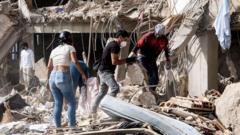
Back-to-back earthquakes struck Venezuela on Wednesday, leaving at least 1430 people dead and an estimated 50,000 missing, as desperate families search through the rubble for loved ones. The coastal state of La Guaira, which borders the capital district of Caracas, has been one of the hardest-hit areas, with catastrophic damage visible across the region.
The magnitude 7.2 and 7.5 tremors, the latter being one of the strongest recorded in the country in decades, caused hundreds of buildings to collapse. Thousands of Venezuelans are believed to be trapped beneath the debris, and the number of dead and injured continues to rise.
Residents and families are engaged in a race against time, using bare hands and shovels to sift through the wreckage, listening for any signs of life. Drones are being used to scan overhead, but the scale of the disaster has overwhelmed local rescue capabilities. Humanitarian aid agencies emphasize that the first 48 to 72 hours are critical for survival, though this window can be extended if those trapped have access to food and water.
Jorge Rodríguez, president of Venezuela's National Assembly, acknowledged the severity of the tragedy, stating, "Every person saved is a miracle. We will not hide anything about the scale of this tragedy." International rescue teams from Mexico, Spain, the United States, and the United Kingdom have arrived to assist, but officials note that the current efforts are still insufficient given the immense needs.
In Catia La Mar, a town in La Guaira state, the mood is somber, with few structures left standing. Government forces have begun distributing food and water to survivors, and interim President Delcy Rodríguez has pledged a comprehensive government rescue response. However, many individuals are left to their own devices, searching for relatives in precarious conditions.
Jesús Suárez traveled 200 kilometers (124 miles) in search of his son, Jean Suárez, who he believes is trapped in a collapsed building. "There's no information at all," Suárez stated. "People who know him say they didn't see him come out or anything. I believe he might be in there." He expressed the immense difficulty of the situation, lamenting, "It's impossible to rescue him... There is no sophisticated equipment here. A human being alone cannot do it - it's too dangerous."
The lack of heavy machinery and specialized equipment is a recurring challenge for rescue efforts. Relatives are left waiting anxiously near collapsed structures, hoping for any news or sign of their loved ones, facing the grim reality of the limited resources available for extraction.
The disaster has highlighted the vulnerability of the region's infrastructure and the urgent need for coordinated international aid and robust emergency response mechanisms. The coming days will be critical in determining the fate of the thousands still missing and in assessing the full extent of the devastation.
This article was written by AI based on publicly available news reporting. Original reporting by the linked source.