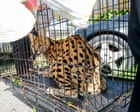
Louisiana firefighters discover African serval during house fire response
Firefighters responding to a house fire in Louisiana found an African serval illegally kept in a backyard enclosure. The wildcat was safely transferred to an animal welfare facility.
Louisiana firefighters discovered an African serval, a wildcat native to sub-Saharan Africa, illegally housed in a backyard enclosure while responding to a minor house fire in Marrero, a suburb of New Orleans. The discovery led to the animal being transferred to an animal welfare facility.
The incident occurred on Tuesday when firefighters investigating a small blaze at a residence noticed the exotic feline. The serval was found confined in a chain-link enclosure that officials described as resembling a cramped baseball batting cage.
Officials from Jefferson Protection and Animal Welfare Services (JPaws) were called to the scene. The agency's director, Michelle Brignac, and humane department supervisor, Victoria Clark, were present when the serval was subdued and placed into a transport carrier. The enclosure itself was reportedly a 9ft-by-9ft space.
According to JPaws spokesperson John McCusker, keeping a serval as a pet in Louisiana requires an exotic animal permit, which the homeowner did not possess. The agency is now working to find a suitable environment for the serval.
Servals are known for their distinctive spotted coats, slender bodies, and impressive leaping abilities, capable of reaching heights of approximately 7 feet. McCusker stated that the serval was given its own room at the JPaws facility while arrangements were made for its relocation.
The animal welfare agency shared photographs of the wildcat, highlighting its striking appearance. The legal ramifications for the owner are not detailed in the provided information, but the lack of the required permit indicates a violation of local ordinances.
This incident underscores the challenges faced by animal welfare organizations in dealing with illegally kept exotic pets. Such animals often require specialized care and environments that are difficult to replicate in domestic settings.
JPaws is actively seeking an appropriate placement for the serval, emphasizing the need for a facility equipped to handle the specific needs of this wild species. The agency's swift action ensured the animal's safety and began the process of relocating it to a more suitable habitat.
This article was written by AI based on publicly available news reporting. Original reporting by the linked source.